

If you’re a localization manager, your job is to create a system that brings together code, design, marketing, linguists, and tools. That system is called a localization strategy.
This guide is based on the real-world insights and success stories shared by experts on the Agile Localization Podcast. We’ve taken those expert conversations and turned them into a practical roadmap.
We are going to discuss the theory shortly and look deeply at the practical steps, so you can architect a system that scales without breaking.
What is a Localization Strategy?
Localization strategy is a plan for how your company is going to adapt its product, marketing, and brand to a new market. While translation handles the words, a localization strategy handles technical requirements, local regulations, and even the way your UI looks on the screen.
Your localization strategy defines the logistics: which tools you will use, which vendors you will hire, and how the teams will communicate. The strategy maps out the exact order of operations to ensure that everyone is on the same page later in the process.
5W1H Framework for Localization Strategy
You have probably heard of the 5W1H framework, which can be used almost in any industry, indeed in localization. Based on this framework, we built the following questions, answers to which you can use to shape your localization strategy:
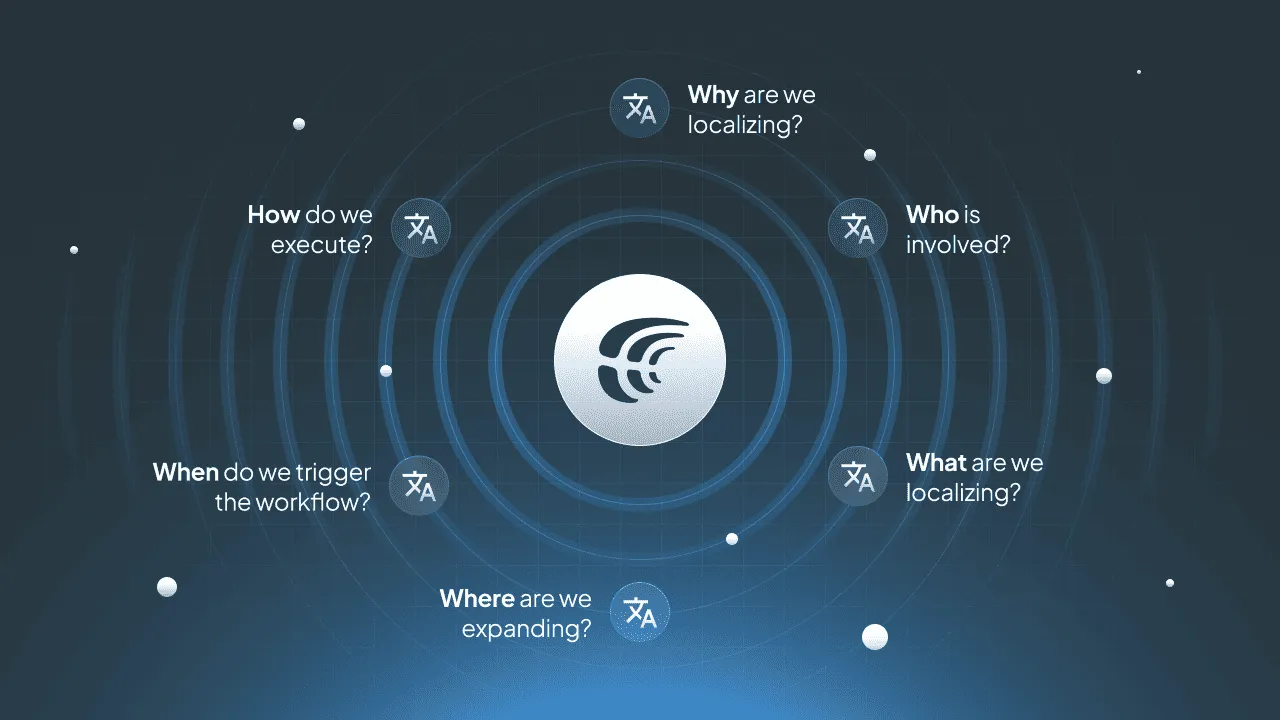
1. Why are we localizing?
- To grow our revenue through new markets.
- To be compliant with local regulations.
- To reduce the load on English-speaking support.
2. Who is involved?
- Localization manager.
- Developers and product managers.
- Linguists.
- Legal and safety officers.
- Target persona.
3. What are we localizing?
- Product/UI
- Safety Documentation
- Marketing/SEO
- Dynamic Content
4. Where are we expanding?
- Tier 1. High-revenue markets.
- Tier 2. Testing markets.
- Tier 3. Experimental markets.
5. When do we trigger the workflow?
- Continuous Model
- Waterfall Model
6. How do we execute?
- Translation management system (TMS).
- Automation. Connectors/APIs to move content from the repo to the TMS.
- Verification. QA checks and Linguistic QA (LQA).
5W1H Framework Example
To visualize how this looks in practice, let’s imagine a SaaS company that has just been told by the CEO to scale from the US to Japan and South Korea. Here is how the localization manager would frame the strategy using the 5W1H method:
| Question | Answer |
|---|---|
| Why? | To capture 20% growth in the APAC region and reduce support ticket volume from non-English speakers by localizing the Help Center. |
| Who? | Owner: Loc Manager. Enablers: DevOps (GitHub sync). Translators: A Japanese LSP and freelance South Korean translators. |
| What? | Tier 1 (High Quality): App UI, Checkout Flow, Marketing Ads. Tier 2 (Using AI): Help Center articles and transactional emails. |
| Where? | Content lives in GitHub (Product), Contentful (Blog posts), MailChimp (Emails), and Zendesk (Support). Localization happens inside Crowdin to centralize all the work. |
| When? | Translations are triggered every Tuesday when the devs push a new release candidate to the staging environment. |
| How? | An AI Pipeline (Context -> MT -> Self-Correction) handles the first draft, and a human LQA (Linguistic QA) ensures the UI doesn’t break. |
That is a raw example, but it should help you build your own localization process strategically.
What Your Localization Strategy May Look Like
Every company is different, so there is no one-size-fits-all plan. Below, we created a strategy that moves from the business goals down to the technical details. You can use this as a skeleton and adapt it to fit your specific product and team.
1. Align with the CEO’s Strategy
Every strategy starts with a business directive. The CEO decides which markets to enter based on growth data. Your job as a localization manager is not to pick the country, but to validate the technical readiness for that country.
This is the best time to ask questions, share your opinion, and vision. Clear up all things before the start.
2. Check the Technical Foundation
If the CEO has already decided to scale, your priority is internationalization (i18n). This is the technical preparation that makes your code capable of handling multiple languages. Without this foundation, your automation will fail.
To prepare for i18n, devs must move all text from the code into key-based resource files (like .json or .yaml) so the TMS can manage it without touching the logic. They need to replace concatenation with full strings and placeholders to allow for different word orders in languages like Japanese.
Finally, the site must be set to UTF-8 encoding with flexible CSS to handle character expansion and non-Latin fonts. This will ensure the UI does not break when the text grows or flips direction.
3. Audit the Content Ecosystem
Map out every place where your content lives:
- Product: GitHub / GitLab / Bitbucket / Azure Repos
- Marketing: WordPress / Webflow / Iterable / Marketo / HubSpot Marketing Hub
- Support: Zendesk / Intercom / Kustomer
- Multimedia: YouTube / Training videos
Depending on the company size, you may find that content lives in 20 different tools.
4. Integration-First TMS Selection
Do not pick a translation management system based on its UI. Pick it based on its connectors. If your marketing team updates a blog in Webflow or a help article in Zendesk, but your TMS does not have a live connector, you will waste your team’s time. Look instead for a TMS like Crowdin that should have integrations with all your existing tools.
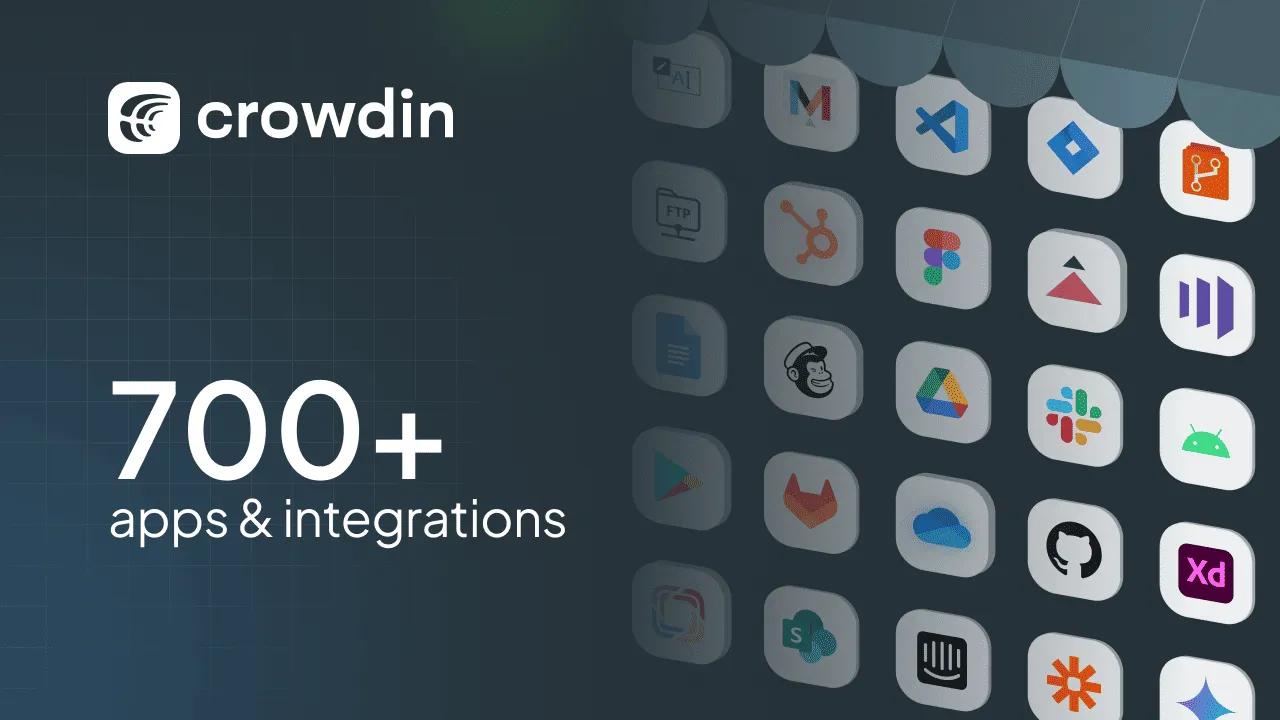
Automation helps to eliminate the risk of version-control chaos and manual copy-paste errors. With direct integrations, you can ensure that every update is synced and tracked.
5. Design the Workflow
Decide the localization path for each content type. Small example:
- Product code might go through AI + Human Review.
- Help articles might go through AI + Automated QA.
- Marketing materials might go straight to a creative translator.
6. Use Glossary and Translation Memory
To save money later, build your glossary and use Translation Memory (TM) for approved translations. If you provide a vendor with a clear list of do-not-translate terms and a style guide upfront, you avoid expensive “re-work” and corrections later.
Even if you have zero budget for humans, a good glossary ensures the AI does not translate your brand name or specific feature names incorrectly.
7. Find Your LSP Partners
A localization manager has several paths here, his choice depends on the goals. You might partner with an LSP (Language Service Provider), or you can create your own team of freelancers.
If you are looking for speed, you can choose vendors directly from the Crowdin Store, which allows you to add professionals directly into your workflow with one click.
8. AI and Machine Translation (MT)
Use AI and MT for the raw translations. They handle 80% of the work. Your strategy should define which AI engine or MT works best for which language (e.g., DeepL is often better for European languages, while others might excel in Asian markets). Test, choose, and connect inside the TMS.
Do not use AI out-of-the-box: test different prompts and models, and build your own strategy.
9. Provide Context
A word without context is just a guess. If a translator sees “Home”, they do not know if it means a house, a landing page, or a button. Providing context is the only way to avoid ambiguity.
4 Layers of Context in Crowdin:
- Screenshots: Mapping images to strings so translators see the exact UI layout.
- In-Context Preview: A live proxy that allows editing directly on a “mirror” of your website.
- Developer Comments / Text: Metadata pulled from code.
- AI-Generated: Use Context Harvester CLI, which can go through your code and generate text context for each string.
Context isn’t just for humans anymore. It is also a part of prompt engineering for LLMs. When you feed AI your glossary and string descriptions, the output shifts from a generic “machine guess” to a brand-aligned translation. By giving the AI the full picture, you cut the time and cost needed for human post-editing.
10. Build Your AI Pipeline
When you give AI too many rules at once (glossaries, tone of voice, character limits, etc.), it often hallucinates or ignores constraints. The idea is to break the process into a sequence of manageable steps so that AI can execute commands one by one.
If you prioritize quality over speed, the Crowdin AI Pipeline is for you. Unlike basic AI, which handles everything in a single request, this tool treats translation like a sequence of tasks.
One of the most practical features for a localization manager is the debugging module. If a translation looks bad, you do not have to guess why. You can inspect the “Input” and “Output” of every single step in the chain to see exactly where a constraint was ignored. This allows you to improve your prompts over time.
11. Implement a Multilevel QA Strategy
Once the translations are out of the AI Pipeline, you need to ensure they actually work in the real world. A translation is useless if it breaks the layout or uses terminology that does not make sense in context. To solve such issues, you can use the following strategies:
- AI QA Checks: Before a human even looks at the text, use Automated AI QA (that can be a part of the AI Pipeline) to catch the rude mistakes. TMS tools can automatically flag if the AI missed a glossary term, ignored a character limit, or accidentally deleted a placeholder (like
{user_name}). - Localization Testing: Visual testing catches text overflow or overlapping buttons, while functional testing ensures that dates, currencies, and right-to-left (RTL) layouts do not break the code.
- Linguistic QA (LQA): This is the final check. Fluent reviewers ensure the tone matches the brand and culture.
12. Continuous Improvement
Localization strategy should continuously adapt. Use Pre-translation Accuracy Reports to see which languages AI handles best. If accuracy is 95%, automate more. If it is 40%, refine your prompts.
Your strategy should not live in a localization bubble. Get feedback from your Sales and Account Management teams in each country. They are on the front lines and will hear first if a translation feels “robotic” or if a specific term is not resonating with the local market.
With reports and sales team feedback, you can constantly update your glossary and AI Prompts for better output.
Advanced Section: Design, SEO, ASO, and Video Dubbing
Beyond text translation processes, there are many other aspects you need to consider in your localization strategy.
1. Design-Stage Localization
- Strategy: Do not wait for the code to see the layout. Use the Figma integration to push translations back into the design files early.
- Empower designers to “stress-test” their layouts with real translations or pseudo-localization. If the Japanese font looks weird or the layout needs to be mirrored, they should fix it in Figma, not in the final production code.
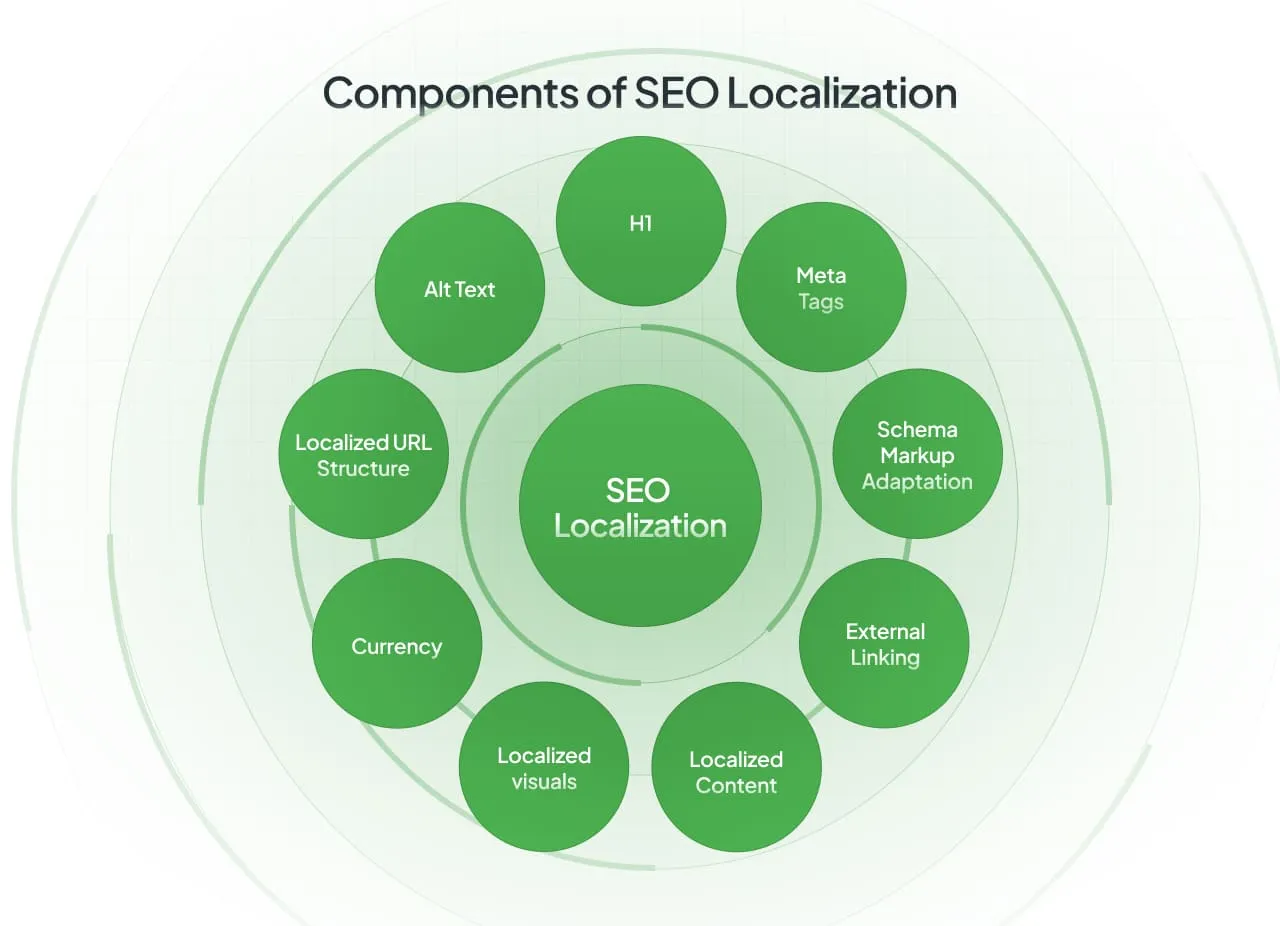
2. SEO Localization
There is no point in having a localized site if Google can’t find it.
- Strategy: Your SEO team can find the local keywords, but you have to make sure they actually get used. Add those high-volume local keywords to your glossary.
- Integration: Treat SEO metadata (H1 tags, meta descriptions, and alt-text) as high-priority strings. If the keywords people are searching for don’t match the terminology inside your app, the user experience is poor, and your ranking will suffer.
3. App Store Optimization
If your app is on App Store or Google Play, localizing the storefront is just as important as localizing the app itself. If a user in Brazil sees a localized app name but the screenshots still show English text, they probably will not hit the download button.
- Test: Try different visuals for new countries.
- Automate: Don’t do this manually. Connect your App Store or Google Play account to your TMS.
- Use the TMS to manage everything from the release notes to the localized app screenshots. If a user sees their own language in the store, your conversion rate can jump.
4. Video and Audio Localization
Video is usually the forgotten content because it has historically been too expensive to localize. However, if you have YouTube tutorials, social ads, or internal training, you can’t just leave them in English.
- Strategy: Instead of hiring expensive studios and voice actors, use the Crowdin Dubbing Studio. Integrated with EvelenLabs and LipDub AI, it allows you to manage the entire video lifecycle (from transcription to AI lip syncing) in the same place you translate your content.
- The biggest win here is that transcripts can be reviewed by linguists before the audio is generated. This is the secret to avoiding that robotic feel.
Localization strategy should be the bridge between the Marketing team (SEO/ASO), the Designers (Figma), and the Product. So do not forget about those components in your localization strategy.
Explore Localization Resources
Get industry insights and practical tips. We prepared webinars, e-books, free courses, podcast episodes, and other content for you.
Check it Out
Common Mistakes to Avoid in Your Strategy
Even with a perfect tech stack, a localization strategy can fail if you overlook the human and operational side of the business. Here are 3 critical areas to monitor:
1. Avoid Over-Localization
Not every market needs a 100% localized experience on day one. A common mistake is spending 40% of your budget on a deep, technical Help Center localization for a market that only has 10 users.
Tip: Use a tiered expansion model. Start with one localized landing page + ads to test the demand. Only move to full-product localization once the data proves the market is worth the investment.
2. Optimize Content for Localization
Localization is often seen as a last step in the marketing or dev chain. If your content creators do not know the localization rules, they will write text that is impossible to translate cheaply.
Tip: Train your content writers in source content optimization. Teach them to avoid local idioms, slang, or cultural references that do not make sense in Japan or Brazil. Writing in global English from the start can slash your translation costs. Moreover, always check your source content for mistakes. One error in the original English text will turn into 10 mistakes if you are translating into 10 languages.
3. Check for Regional Functional Requirements
A product that speaks the language but can’t take the money will fail. If your strategy ignores local payment methods, date formats, and units of measurement, your “localized” app will still feel like a foreigner.
Tip: Collaborate with your Product and Finance teams early. In some markets, users won’t use credit cards (requiring local options like Pix in Brazil or Konbini in Japan).
Build Your Custom Localization Strategy
The 12 tips above provide a framework, but the most important thing to remember is that a modern localization stack is fully modular. It should look more like a set of Lego bricks.
In Crowdin, we do not force you into one workflow. Instead, we give you the blocks – AI pipelines, integrations, QA checks, and vendors – and you can build the custom setup that fits your business best.
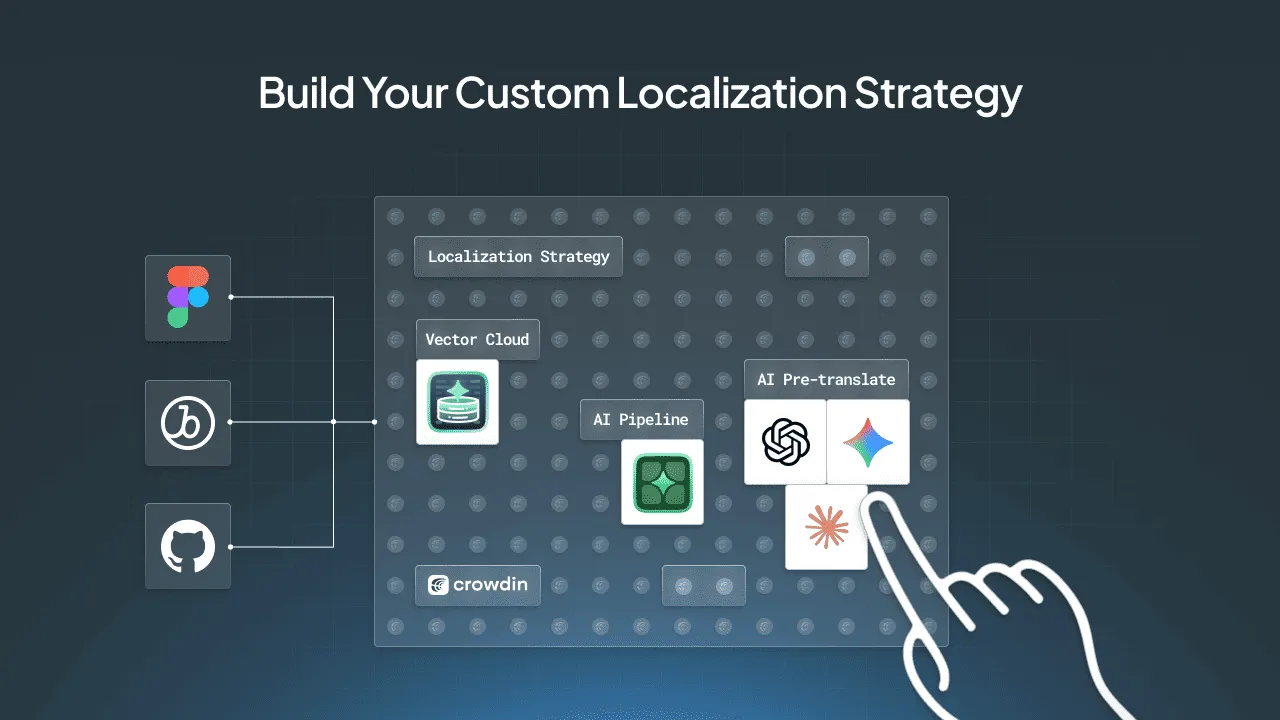
You are the architect. You can swap out an AI engine, add a “new brick”, or change the order of your QA steps as you scale. Your strategy is a living system that could grow and change. Build the workflow that works for your team today, and know that you can always rebuild it for tomorrow.
Do not be afraid to break the rules of this framework. Whether you need to swap out a vendor, add a new AI layer, or integrate a niche quality-checking tool, your tech stack should be flexible enough to serve your needs.
Localize your product with Crowdin
FAQ
What is a localization strategy?
A localization strategy is a company’s approach to adapting its content, marketing efforts, products, and services to connect with the local market customers.
Why do I need to build a localization strategy?
A localization strategy helps businesses to avoid common localization mistakes, helps with international growth, shortens time to markets, gains numerous benefits, and improves customer engagement.
What is the best software to manage localization processes?
Crowdin is a platform that will help your team with translating business content, including software, module apps, websites, marketing content, help center, and games.

Yana Feshchuk
Yana Feshchuk is a Partnerships Marketing Manager. Her expertise lies in developing authoritative and well-researched content for the localization field.